

 Facebook
 X
X
 Pinterest
 Copy Link
What Is Happening at 1125 Moss Street in Reading?
A former hosiery mill at 1125 Moss Street in Reading, Pennsylvania, is being transformed into a proposed 55-unit apartment complex.
The century-old brick building was constructed around 1917 and originally housed the D.S. & W. Hosiery Company. It later became associated with the Great Factory Store Outlet before sitting vacant or underused for many years.
Today, investors are working to give the building another purpose.
The privately funded adaptive-reuse project is expected to include:
- 55 apartments
- 10 one-bedroom units
- 45 two-bedroom units
- Units ranging from approximately 700 to 1,200 square feet
- Indoor and outdoor parking
- A resident courtyard
- Two additional fifth-floor apartments
- Possible balconies for the top-floor units
A possible 2028 completion was discussed during the presentation, although that remains subject to construction progress, utility improvements, approvals, financing, and unforeseen conditions inside the historic building.
Touring the Project Through R-BAR
I recently attended a Commercial and Industrial Council event organized by the Reading-Berks Association of REALTORS®, commonly known as R-BAR.
Mark Mohn, R-BAR’s government affairs director, introduced the project before developer Chris Posch gave attendees a presentation about the building’s history, acquisition, construction work, apartment plans, and challenges. After the presentation, Chris allowed the group to walk through the building and see the redevelopment work firsthand.
The tour included the future apartment spaces, elevator, stairwells, interior framing, replacement windows, parking areas, and the future resident courtyard. Views from the third and fourth floors also provided a different perspective of the surrounding Reading neighborhood, with the Pagoda visible from portions of the building.
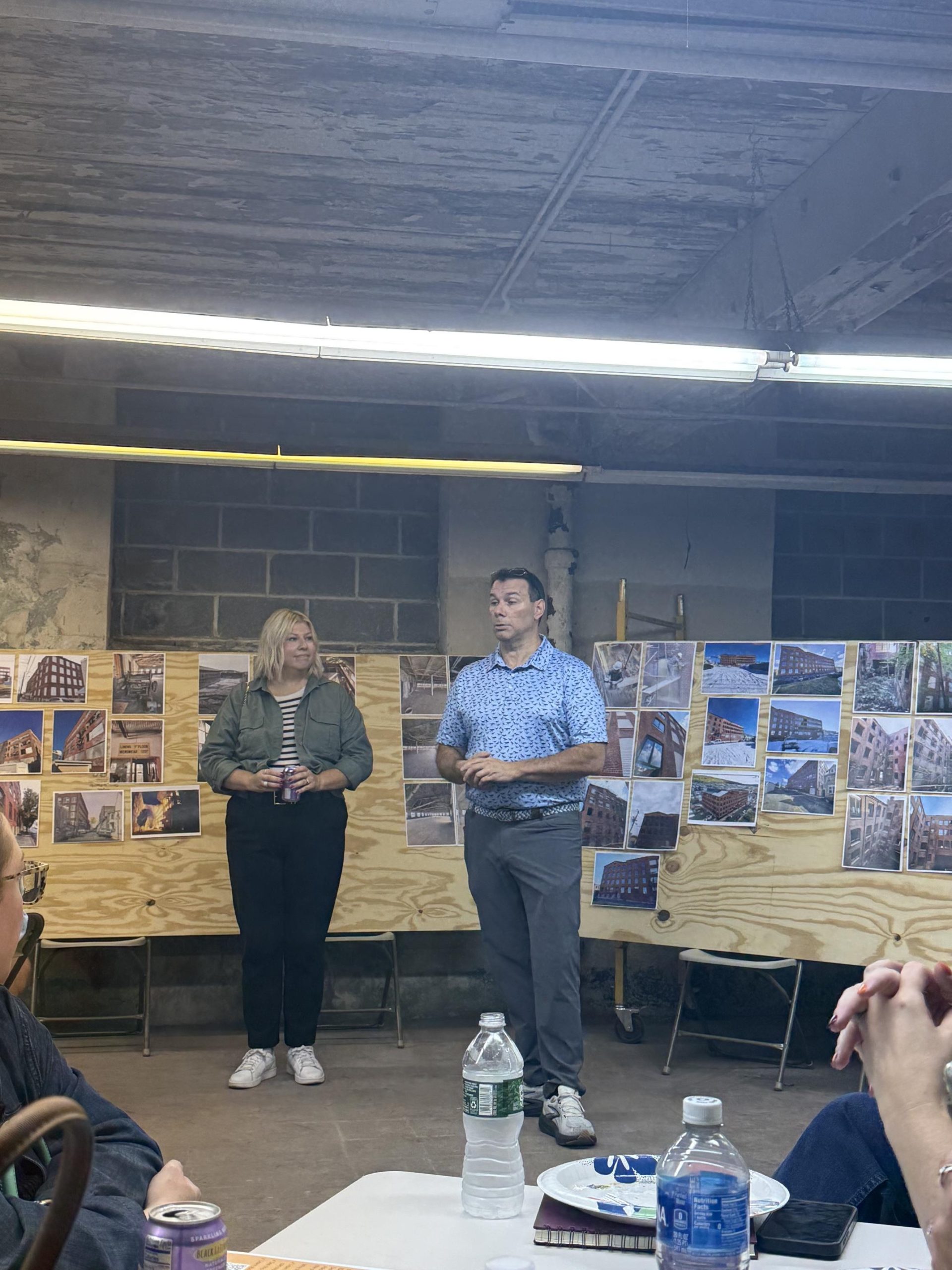
The R-BAR Commercial and Industrial Council organized the presentation and guided walkthrough of the Moss Street redevelopment.
From Hosiery Mill to Housing
The building was originally part of Reading’s extensive textile-manufacturing industry.
The D.S. & W. Hosiery Company was incorporated in 1917 by Daniel J. Driscoll, William W. Staudt, and George S. Weinerth. Historical research indicates that the company employed approximately 250 people shortly after beginning operations in 1918.
The property later became associated with the Great Factory Store Outlet, connecting it to another major part of Reading’s economic history.
Reading was once heavily influenced by textile manufacturing and later became widely known as the “Outlet Capital of the World.” Factory stores brought shoppers into the city from across the region before the local outlet industry eventually declined.
The building at 1125 Moss Street therefore reflects several chapters of Reading’s past. It began as an industrial property, participated in the factory-outlet era, and is now being prepared for residential use.
How the Redevelopment Began
According to Chris, the project began with a cold call.
Chris contacted another investor who was already considering what could be done with the building. The two eventually combined their resources, purchased the property, and began working through the redevelopment process.
Public listing records indicate that the property sold for $450,000 in September 2022. The building had been marketed as a former hosiery factory with tall ceilings, numerous windows, centrally located stairwells, and areas capable of supporting indoor parking.
Unlike a project funded primarily through a public incentive program, Chris described the Moss Street redevelopment as being privately financed through equity capital.
A Greater Reading economic-development profile identifies Chris Posch and Michael Duka as the developers and describes the investment as an approximately $6 million privately financed project.
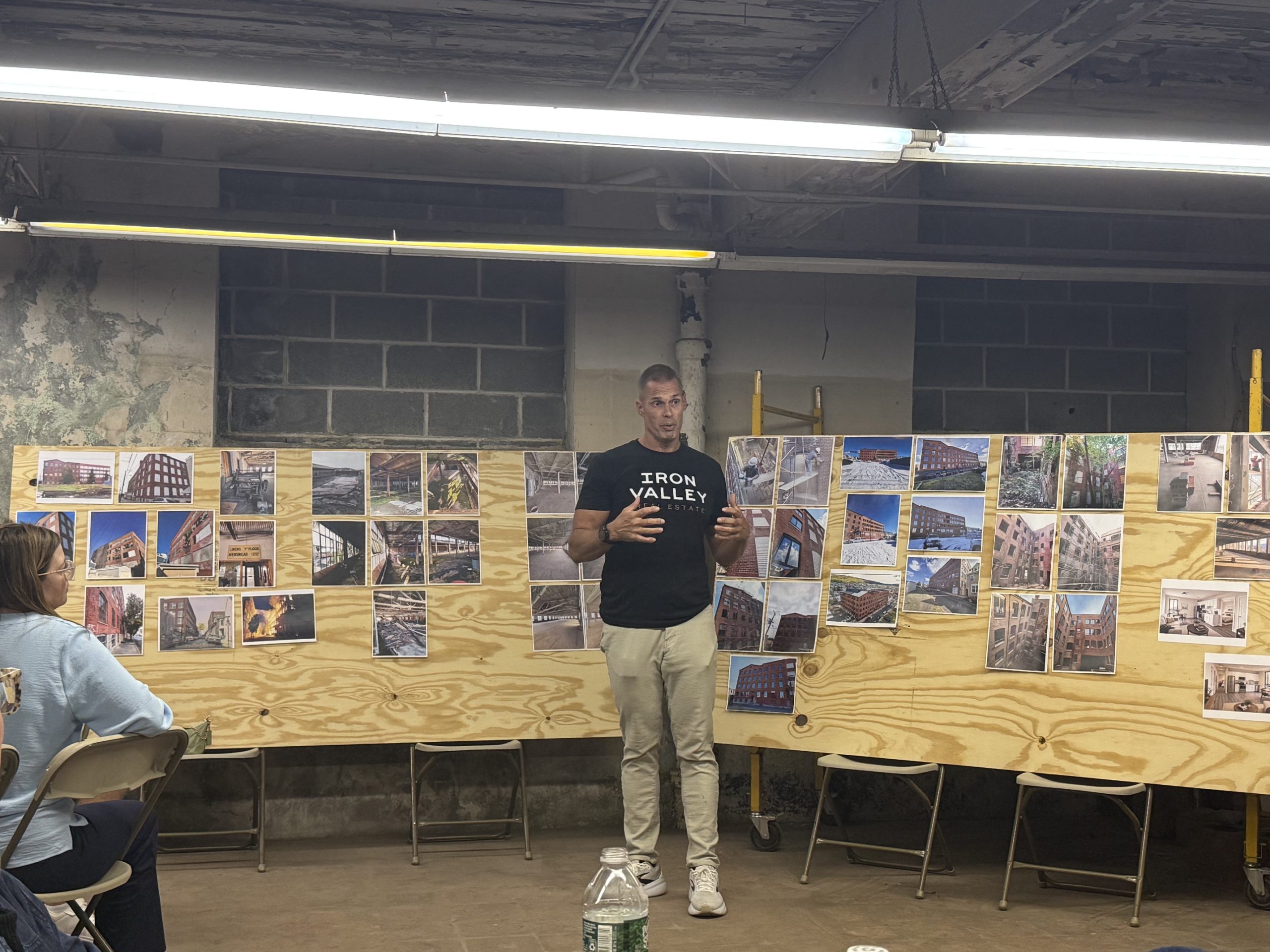
The project’s developer discussed the building’s history, acquisition, construction work, and plans before leading attendees through the property.
Restoring the Building for Another Century
Turning an old factory into apartments is not as simple as installing walls, kitchens, and bathrooms.
The building was originally constructed with substantial timber supports. Chris explained that water is one of the greatest threats to a structure like this because long-term moisture can severely damage wood, mortar, masonry, and other building components.
One of the most extensive parts of the project involved repairing the brickwork.
According to Chris, the development team examined and repaired mortar throughout the building, going line by line through the brick structure to prepare it for continued use. The intention is not merely to make the building habitable now, but to help it remain structurally useful for another century.
Approximately 110 windows were also replaced.
The new windows bring natural light into the future apartments while improving protection from weather and helping preserve the building’s exterior character.
Inside, framing is beginning to show how former industrial floor space can become individual apartments. Major electrical work took place, as well. The property’s power lines had to be upgraded before the electric utility could provide sufficient service for 55 residential units and the building’s common systems.
This kind of work is often invisible once a development is finished. During construction, however, it becomes clear how much time and money must be invested before an old industrial building can safely serve a new purpose.
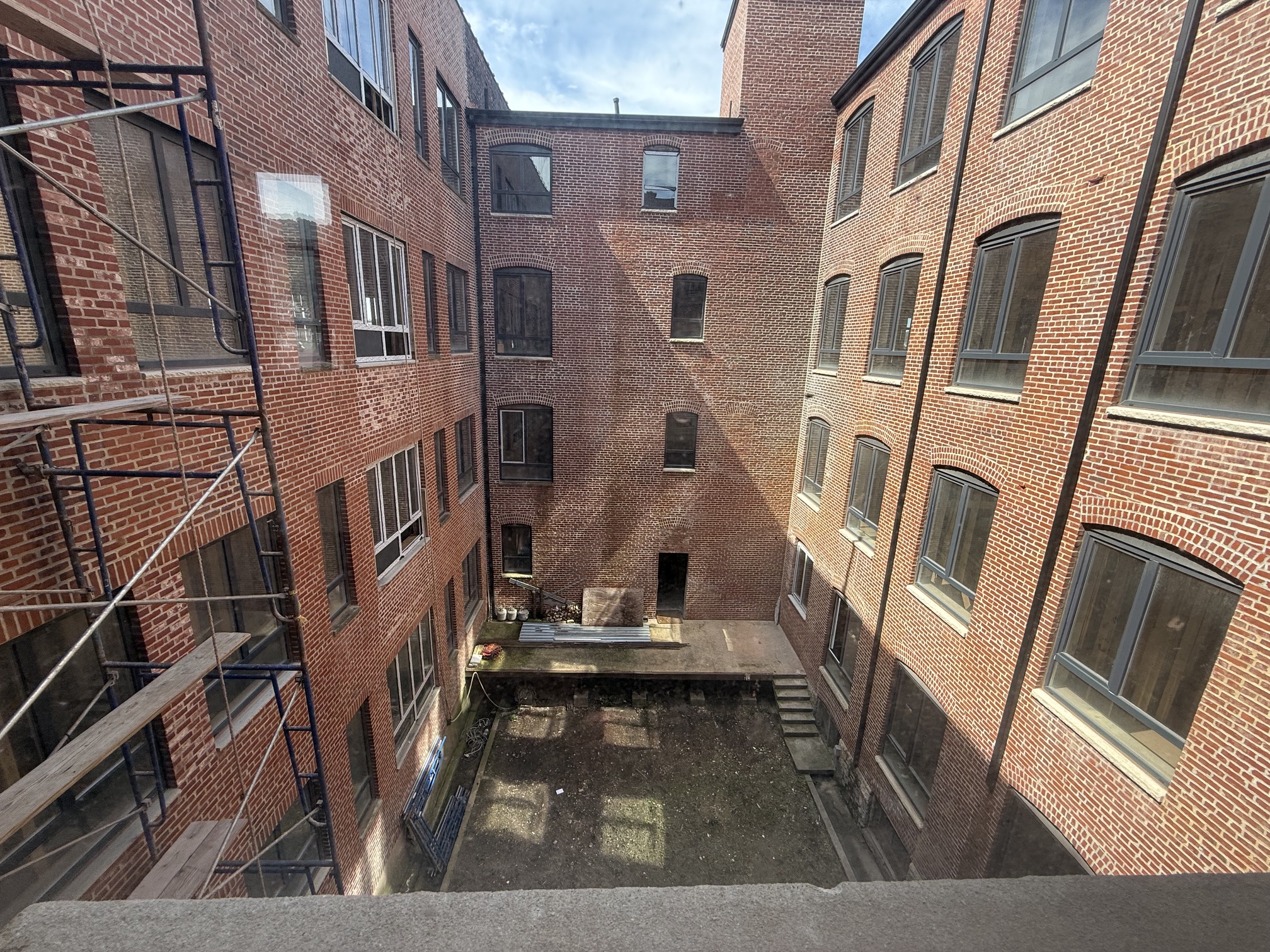
The future resident courtyard is enclosed by the restored brick walls and replacement windows of the former hosiery mill.
What Is Being Built?
The current plan calls for 55 apartments:
- 10 one-bedroom apartments
- 45 two-bedroom apartments
- Approximately 700 to 1,200 square feet per unit
The building’s large windows and former industrial layout provide opportunities for apartments with substantial natural light and views across the surrounding area.
The development team was also able to add two apartments on the fifth floor. Those top-floor units may eventually include balconies, although that feature should currently be described as a possibility rather than a finalized part of the project.
A courtyard is planned within the center of the building. Once completed, the courtyard could give residents an outdoor common area enclosed by the mill’s historic brick walls.
The courtyard is one of the project’s most interesting features because it uses the building’s existing shape to create a space that would be difficult to reproduce in conventional new construction.
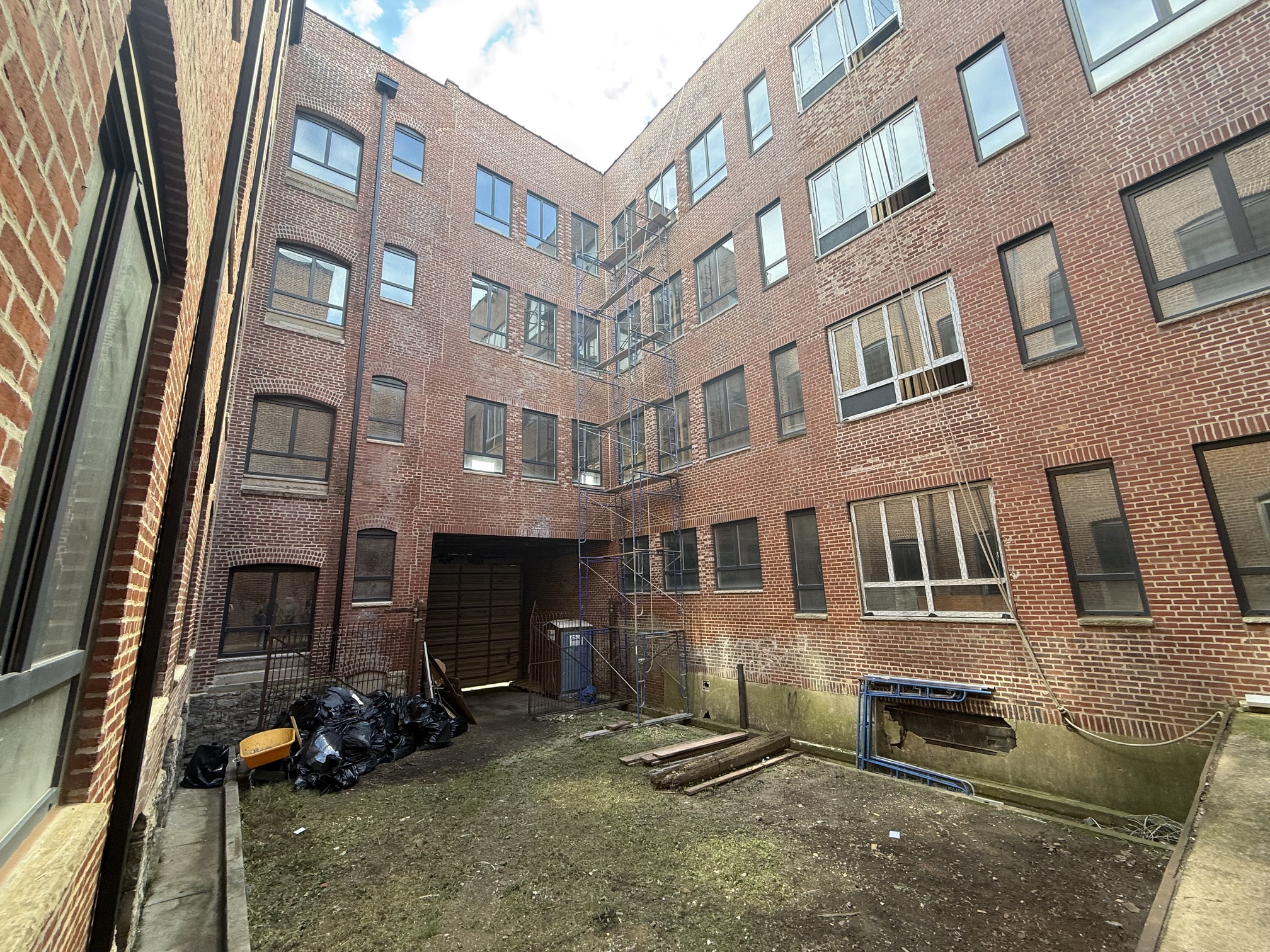
The enclosed courtyard is planned as an outdoor common area for future residents.
Parking and Infrastructure
Parking is one of the biggest practical challenges involved in converting older urban buildings into housing.
The project currently anticipates approximately 37 indoor parking spaces, along with a paved and lighted surface lot across Moss Street containing roughly 40 additional spaces.
The City of Reading’s 2023 zoning decision refers to a proposal for 76 spaces where 83 would ordinarily have been required.
The zoning decision also identifies the project as a proposed 55-unit adaptive reuse and discusses combining nearby Moss Street properties for the surface parking area.
Chris also discussed another redevelopment project where parking has become more difficult. That comparison demonstrates why parking must be considered early when developers evaluate an old industrial property.
A building may offer enough interior room for housing, but the project still needs practical access, utilities, emergency services, trash collection, and parking.
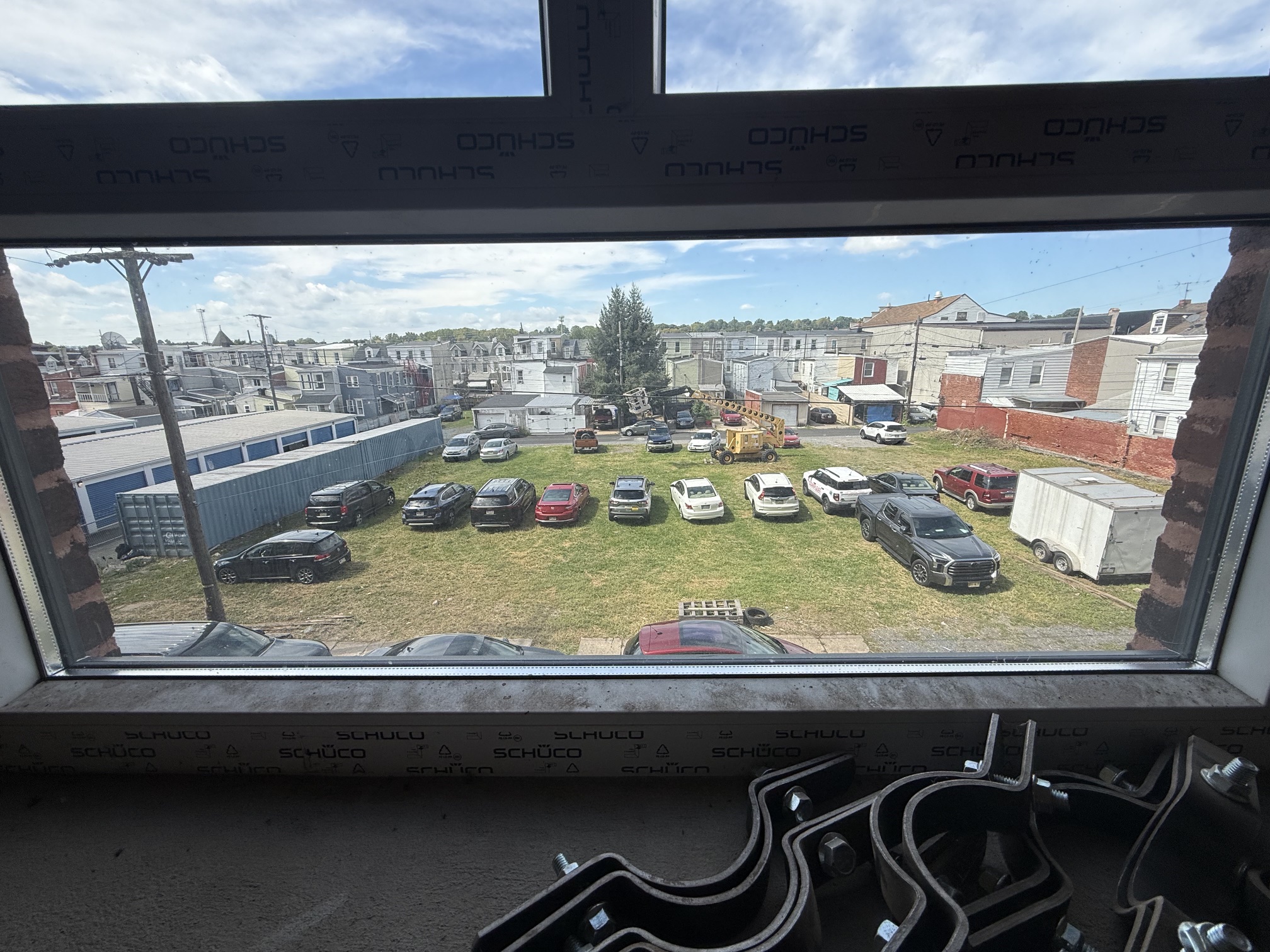
The area across from the former factory is planned to become a paved and lighted parking lot for residents.
Housing for Reading’s Workforce
The Moss Street apartments are intended to provide housing for people working in Reading and the surrounding region.
Chris mentioned potential residents such as:
- Nurses and other healthcare workers
- Construction workers
- DEKA employees
- Warehouse and distribution workers
- Manufacturing employees
- Other people employed in and around Reading
DEKA refers to East Penn Manufacturing, the battery manufacturer located near Fleetwood.
This workforce-housing focus matters because Reading’s redevelopment is not only about attracting outside investors or creating high-end downtown projects. The city also needs functional, quality housing for people who already work throughout Berks County.
The Moss Street project would return a long-vacant industrial property to productive use while adding apartments intended for working residents.
Working With the City of Reading
Developers often describe municipal approvals as one of the hardest parts of completing a complicated urban project.
Chris offered a more positive assessment of the Moss Street experience.
According to Chris, working with the City of Reading has gone well, and the project has not encountered the kind of municipal conflict developers sometimes expect. Chris believes city officials recognize the value of returning the property to useful condition.
That does not mean the project has been simple. Public records show that the development required zoning consideration for adaptive reuse, dimensional relief, parking, and related land-development issues.
The distinction is important. A complicated approval process does not necessarily mean the city and developer are working against one another.
Adaptive reuse requires coordination among developers, attorneys, architects, engineers, contractors, utility providers, zoning officials, planning officials, and other parties. A cooperative relationship can make that process more manageable.
Why This Project Matters to Reading
The Moss Street redevelopment matters because it combines several needs and opportunities:
- Preserving part of Reading’s industrial architecture
- Returning a long-vacant property to productive use
- Creating 55 new apartments
- Providing housing for local workers
- Bringing private investment into an existing neighborhood
- Expanding the city’s residential and property-tax base
- Reducing the risks associated with vacant industrial buildings
- Demonstrating how adaptive reuse can support Reading’s redevelopment
Demolition and replacement are not always the best or most realistic options for Reading’s older industrial properties.
Many of these buildings were constructed with durable brick, timber, large windows, high ceilings, and substantial interior space. When a building can be saved responsibly, adaptive reuse may preserve its historic character while meeting a modern need.
The Moss Street project is a practical example of that process.
What I Saw During the Walkthrough
The scale of the project became much clearer once I entered the building.
The tour included:
- The existing elevator
- Original stairwells
- Exposed timber and structural elements
- Framing for future apartments
- New windows
- Restored brick walls
- Future indoor parking
- The planned courtyard
- Views from upper-floor apartments
- A view of the Reading Pagoda from portions of the building
What stood out most was the contrast between the building’s age and the work being done inside it.
Some areas still clearly resemble an old industrial mill. Other sections are beginning to show recognizable apartment layouts.
That transition is what makes adaptive reuse so interesting. The building is not being erased and replaced. Its original structure is being prepared for an entirely different chapter.
When Could the Project Be Completed?
Work began around 2023, and a possible 2028 completion was discussed during the presentation.
That is a working projection, not a guaranteed opening date.
Historic redevelopment projects can be affected by:
- Structural discoveries
- Utility upgrades
- Material availability
- Contractor scheduling
- Approval requirements
- Financing
- Weather
- Changes to building plans
The amount of work already completed is significant, but several major construction and infrastructure steps remain.
My Takeaway
The most impressive part of the Moss Street project was not simply hearing that 55 apartments are planned.
It was seeing how much work is required to bring a century-old factory back into productive use. Add to that, this project is be financed privately.
Repairing mortar throughout the building, replacing 110 windows, protecting the timber structure, upgrading electrical service, creating parking, and framing dozens of apartments require substantial time, money, and coordination.
It would be easier to look at an abandoned building and see only deterioration.
This project looks at the same building and sees housing, history, investment, and another century of possible use.
I want to thank Chris Posch for explaining the project and allowing attendees to tour the property. I also want to thank Mark Mohn and R-BAR’s Commercial and Industrial Council for organizing an event that gave local real estate professionals a closer look at redevelopment work happening in Reading.
I will continue following projects like this because they help explain how private investment, adaptive reuse, housing, and local planning are shaping Reading’s future.
Frequently Asked Questions
What is being developed at 1125 Moss Street?
A former hosiery mill is being converted into a proposed 55-unit apartment complex.
What was the building originally used for?
The property was originally the D.S. & W. Hosiery Mill and later became associated with the Great Factory Store Outlet.
How many apartments are planned?
The current plan includes 55 apartments, consisting of 10 one-bedroom units and 45 two-bedroom units.
How large will the apartments be?
The planned units range from approximately 700 to 1,200 square feet.
Will the development include parking?
Yes. The project includes indoor parking and a surface parking lot across Moss Street. The final approved parking count should be confirmed before publication.
Will residents have access to outdoor space?
A private resident courtyard is planned within the building complex. Possible balconies are also being considered for two fifth-floor apartments.
Is the project publicly funded?
Chris described the project as privately financed through equity capital.
When could the apartments be completed?
A possible 2028 completion was discussed, but the schedule remains subject to construction, utility work, approvals, financing, and unexpected building conditions.
What is adaptive reuse?
Adaptive reuse means converting an existing building to a new purpose while retaining and improving much of its original structure. In this case, a former hosiery mill is being transformed into housing.
Following Reading’s Redevelopment
Projects like 1125 Moss Street show how Reading’s industrial past can become part of the city’s future.
If you are considering buying, selling, investing, or developing property in Reading or Berks County, I would be happy to help you understand the local real estate market and connect with appropriate professionals.
Contact Ben Perfetto, REALTOR® with Coldwell Banker Realty, to discuss your real estate goals.
